
Introduction
For small and mid-sized enterprises (SMEs), growth in 2026 will be determined not just by sales and marketing but by the efficiency of their operations. With tighter margins, increasing competition, and constant technological change, the companies that succeed will be those that optimize their processes continuously.
Process optimization is no longer about cutting costs alone. In today’s market, it is about creating resilience, improving customer experience, leveraging data for smarter decisions, and enabling innovation without waste.
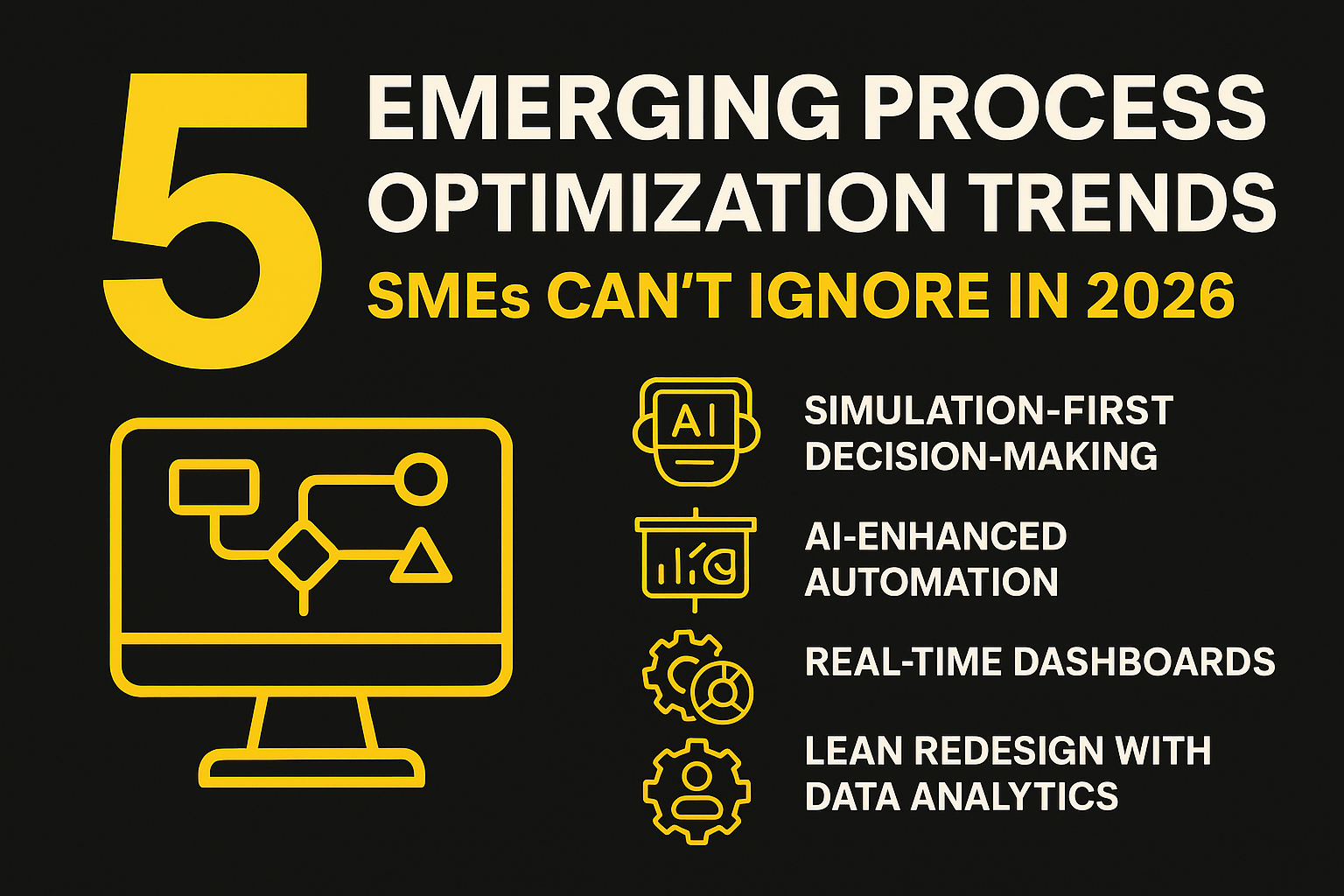
This article explores five emerging process optimization trends SMEs can’t afford to ignore in 2026. Each trend offers practical opportunities to reduce inefficiencies, increase profitability, and build sustainable growth — even in volatile markets.
Why Process Optimization Matters More Than Ever
SMEs face unique challenges:
-
Resource Constraints: Unlike large corporations, SMEs have limited budgets and smaller teams. Efficiency gains go further.
-
Volatility: SMEs are more vulnerable to supply chain shocks, labor shortages, or sudden market shifts.
-
Customer Expectations: Digital-native customers demand speed, personalization, and reliability.
In this environment, process optimization is not optional — it is a survival and growth strategy. McKinsey research shows that organizations with optimized operations are 30–50% more likely to sustain profitability during downturns.
Simulation-First Decision-Making
In 2026, SMEs can no longer afford trial-and-error. Process simulation tools are becoming more accessible and affordable, enabling businesses to test processes virtually before implementing them in reality.
Applications
-
Workflow Testing: Model new sales, customer service, or production workflows to identify bottlenecks before rollout.
-
Supply Chain Scenarios: Simulate delays, price increases, or demand spikes to see how the system responds.
-
Capacity Planning: Forecast staff and resource requirements under different growth scenarios.
Benefits
-
Reduced Costs: Avoid costly mistakes by validating ideas before committing.
-
Faster Time-to-Market: Launch new initiatives with confidence.
-
Smarter Risk Management: Prepare for “what if” scenarios proactively.
Example:
A manufacturing SME used simulation to model different factory layouts. The digital test revealed inefficiencies in material movement. After adjusting before implementation, the SME cut production time by 12% and saved thousands in rework costs.
AI-Enhanced Process Automation
Artificial Intelligence (AI) has moved beyond experimentation. In 2026, SMEs are adopting AI-driven automation not only to eliminate manual work but also to optimize processes in real time.
Applications
-
Customer Service: AI bots handle routine inquiries, freeing staff for complex issues.
-
Inventory Optimization: Algorithms predict reorder points based on demand and supplier reliability.
-
Financial Processes: AI streamlines invoice matching, fraud detection, and expense reporting.
-
Sales Forecasting: Predictive models improve accuracy and reduce over/understocking.
Benefits
-
Scalability: Automate without needing proportional headcount increases.
-
Accuracy: AI reduces human error in repetitive processes.
-
Agility: Processes adapt dynamically as data changes.
Example:
A logistics SME integrated AI into its routing system. Delivery routes updated in real time based on traffic data, reducing fuel costs by 18% and improving on-time delivery by 22%.
End-to-End Process Visibility Through Dashboards
Fragmented information is one of the biggest barriers to SME efficiency. In 2026, SMEs are increasingly using real-time dashboards to unify operational, financial, and customer data in one place.
Applications
-
Sales & Marketing: Track campaign ROI and conversion rates across channels.
-
Operations: Monitor order fulfillment, production times, or service SLAs.
-
Finance: Visualize cash flow and cost centers in real time.
-
People Management: Track productivity, training, and turnover indicators.
Benefits
-
Faster Decision-Making: Leaders act on live data, not outdated reports.
-
Cross-Department Collaboration: Everyone works from the same source of truth.
-
Early Warning Signals: Issues are flagged before they become crises.
Example:
A retail SME introduced a unified Power BI dashboard combining sales, inventory, and customer service metrics. Leaders identified a recurring issue with stockouts in one branch, fixed procurement timing, and recovered $250,000 in lost sales in a year.
Lean Process Redesign with Data Analytics
Lean management is not new, but in 2026, SMEs are combining data analytics with lean principles to redesign processes more effectively.
Applications
-
Waste Identification: Use analytics to find bottlenecks, delays, or rework.
-
Customer Journey Mapping: Analyze drop-offs in digital funnels or service pipelines.
-
Resource Allocation: Match staff time to value-adding activities.
-
Cost-to-Serve Analysis: Identify which products, services, or clients are profitable.
Benefits
-
Increased Profitability: Eliminate non-value activities.
-
Better Customer Experience: Streamlined processes reduce friction.
-
Continuous Improvement: Data reveals new optimization opportunities regularly.
Example:
A professional services SME applied lean analytics to its proposal process. By analyzing cycle times, it discovered that manual approvals were delaying responses. Automating this step reduced proposal turnaround from 10 days to 3 — and win rates increased by 20%.
Human-Centered Process Improvement
Technology can optimize processes, but people ultimately run them. In 2026, successful SMEs recognize that human-centered design is key to process optimization.
Applications
-
Employee Involvement: Staff closest to the work identify inefficiencies leaders may overlook.
-
Upskilling Programs: Training employees in problem-solving and data literacy increases innovation.
-
Change Management: Supporting staff through transitions reduces resistance and failure rates.
-
Customer Co-Creation: Involving customers in redesigning service processes ensures higher satisfaction.
Benefits
-
Higher Adoption Rates: Processes succeed when employees feel ownership.
-
Reduced Turnover: Empowered teams are more engaged.
-
Customer Loyalty: Improved service design aligns with real customer needs.
Example:
An SME in hospitality redesigned its booking process after surveying frontline staff and customers. Simple changes to communication workflows cut booking errors by 35%, boosting both employee satisfaction and guest loyalty.
How SMEs Can Prepare for 2026
To take advantage of these trends, SMEs should:
-
Adopt Simulation Tools: Start small with free or low-cost platforms.
-
Pilot AI Automation: Begin with repetitive tasks like invoicing or FAQs.
-
Invest in Dashboards: Even simple visualization tools improve decision-making.
-
Apply Lean Analytics: Review key processes quarterly for inefficiencies.
-
Empower People: Build a culture of continuous improvement where staff and customers have a voice.
In 2026, SMEs that treat process optimization as a strategic priority — not a side project — will gain the edge. By combining simulation, AI, dashboards, lean analytics, and human-centered design, businesses can unlock profitability, reduce risks, and build resilience for the future.
👉 Next Step: Dive deeper into each trend in our upcoming guides on simulation, AI automation, and lean analytics — and start building the SME processes of tomorrow, today.